C&C 34+
LOA: 35' 6" LWL: 30' 10"
Boats Names:
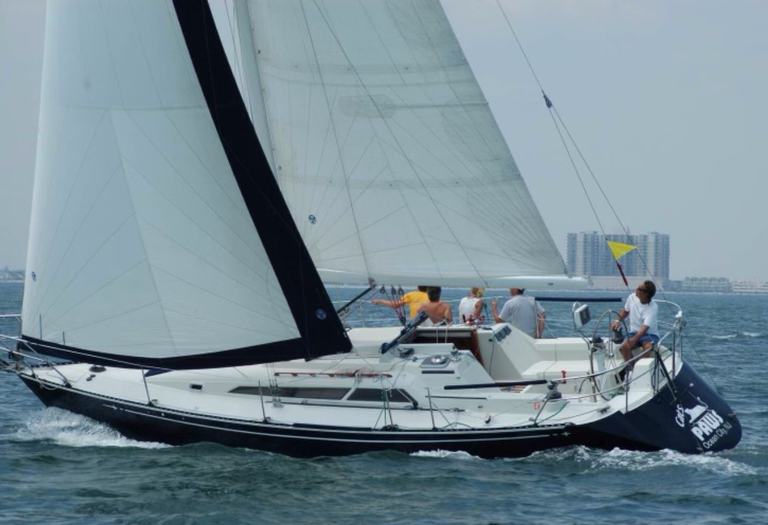
Cats Paws
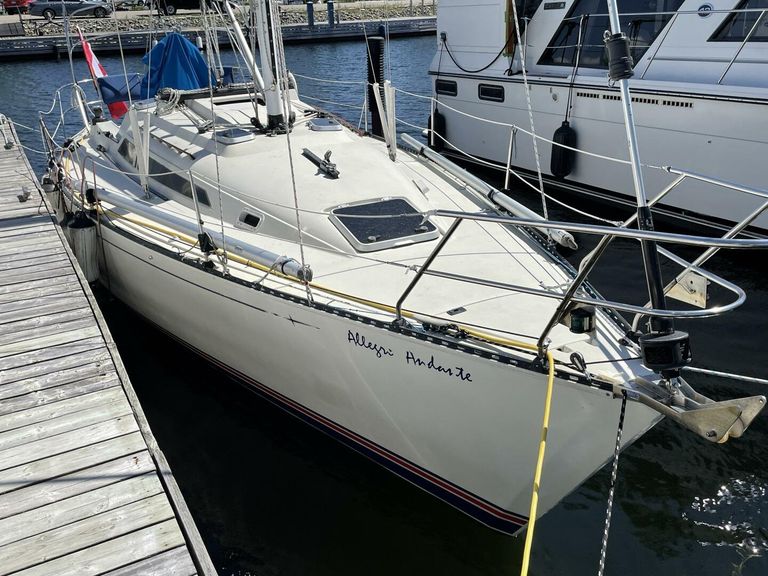
Allegro Andante
Job #
89-1
Designer / Draughtsman:
C&C Design Group,
Year of Design
1989
Builder
C&C International Yachts Ltd.
Notes
Its most recent 34R and 37R models represented the strongest commitment C&C had made to chasing racing clientele in years. In retrospect, some of C&C's problems in the 1980s were caused by trying to serve a market that no longer existed.
The days of the dual-purpose racer-cruiser -- at least one that could win a major title like SOR — were long gone. The IOR was king on the race course, and it was difficult to create a design that could find success in gran prix events and then be transformed into a production series racer-cruiser. What C&C needed was the IMS rule, but IMS would take until the end of the decade to catch on.
Recent designs like the 34R and 37R were created with the IMS in mind, and were offered in racer/cruiser "+" versions. It's too soon to tell whether or not these latest efforts rank with the greatest of C&C's designs.
Doug Hunter
C&C 34+
2022 January 1
By DAVID LISCIO
Save This racer-cruiser makes for spirited club racing and great family cruising
When Canadian-born naval architect Rob Ball talks about favourites among the dozens of boats he designed for C&C Yachts, he lists the C&C 34+ racer-cruiser as one his best. During an October 2021 discussion forum that was hosted online by the Robert Perry Fan Club and streamed on Zoom, Ball singled out the C&C 40 and the C&C 34+ as close to his heart. “I would like to own a 34+ for myself,” he said. Ball, now in his 70s, formally joined the C&C Yachts staff in Ontario in 1969 when he was assigned to designing masts and other equipment. He had previously contributed designs to the company while still in school.
By 1973, Ball had been named the company’s chief in-house designer, a position he held until 1990. Founded in 1961 by mechanical engineer George Cuthbertson and aircraft designer George Cassian, C&C Yachts achieved rapid success and for more than three decades was celebrated for its innovative designs, included the balsa-cored deck and hull. Unlike a solid fiberglass hull, boats with core hulls and deck proved lighter, faster, and more maneuverable.
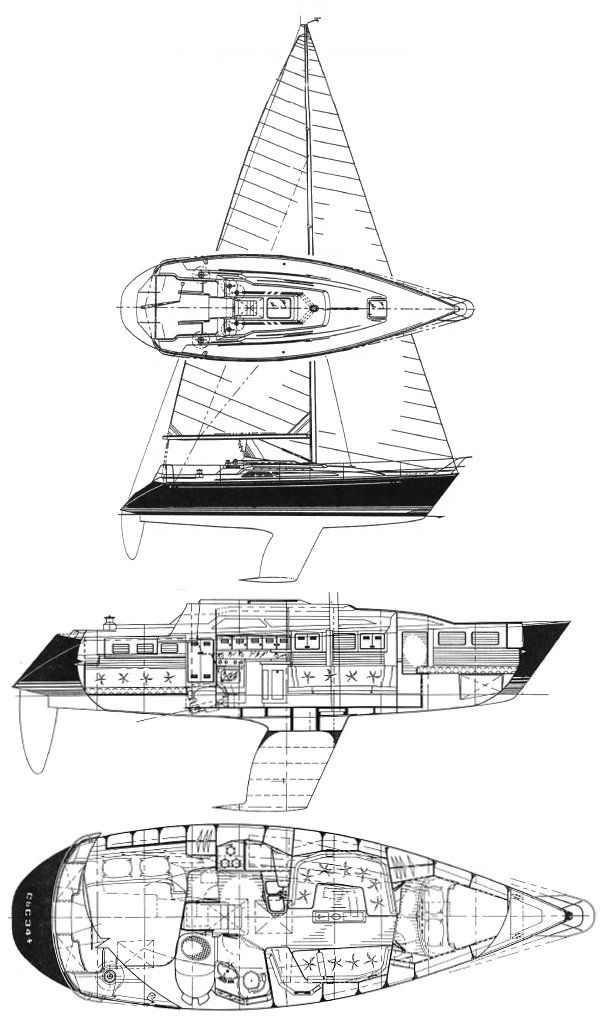
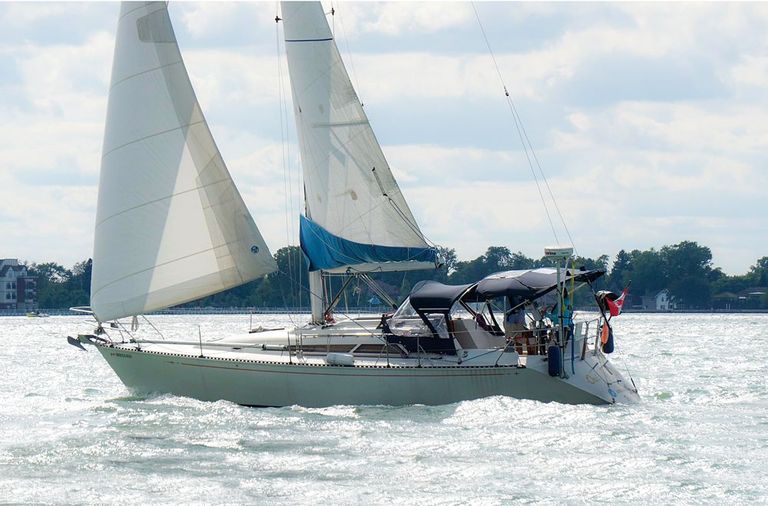
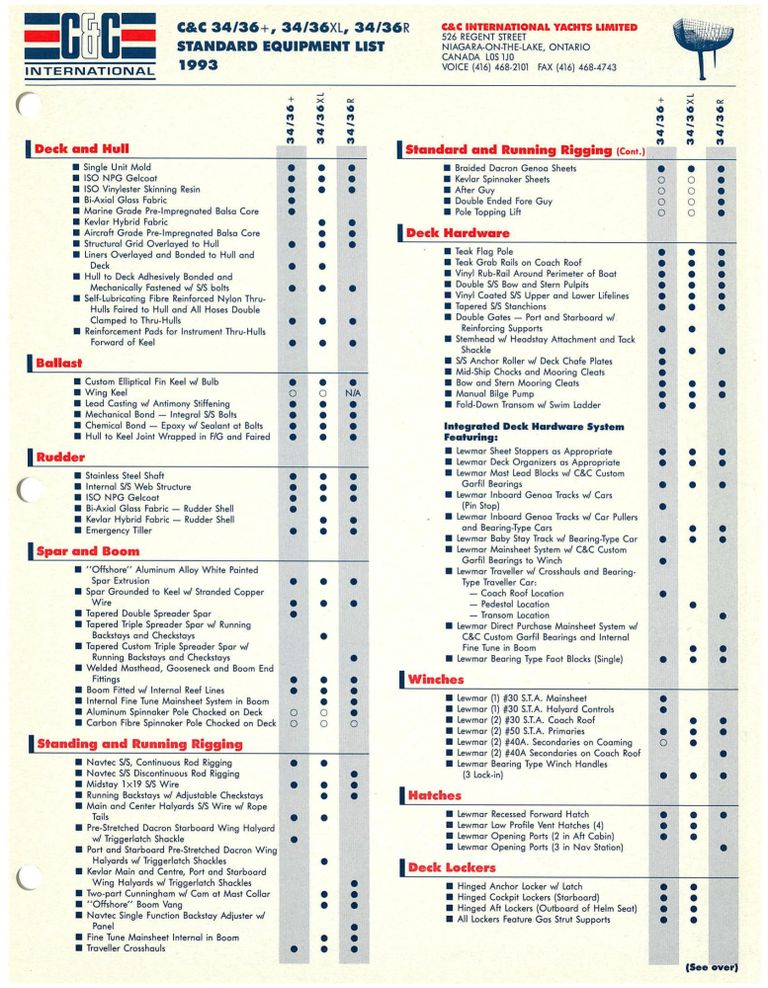
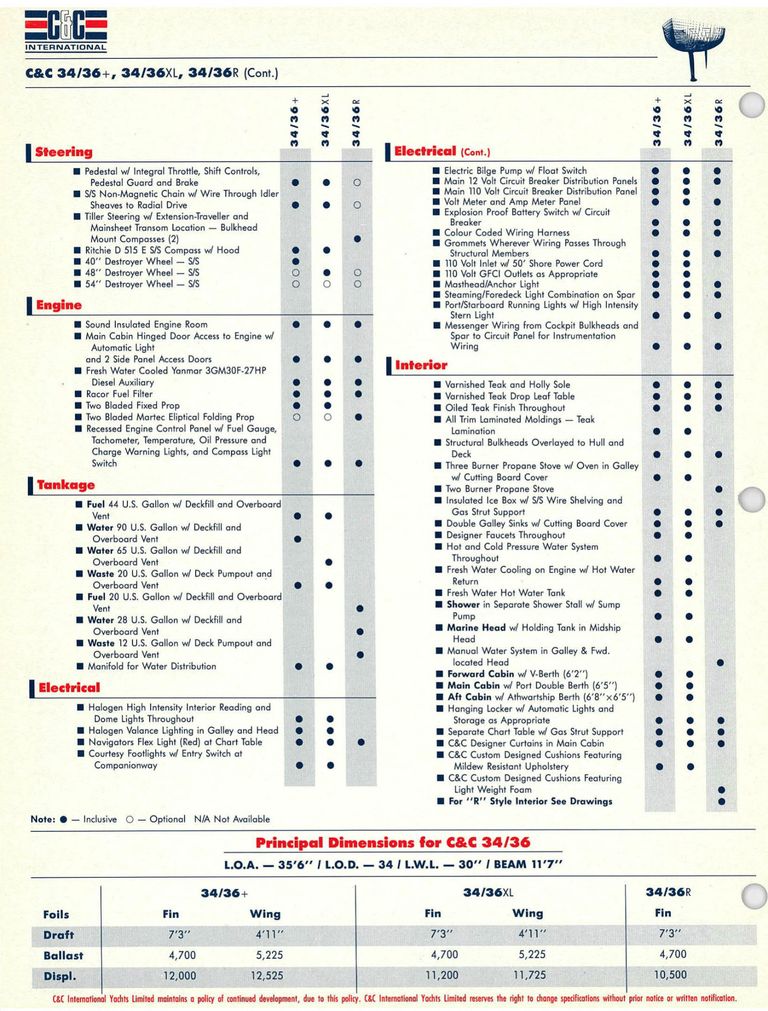
The original C&C 34, also designed by Ball and introduced in 1977, was primarily viewed as “a basic sailboat” that satisfied the needs of its many owners. The C&C 34 was eventually overshadowed in 1989 by the release of the C&C 34+, which was a dramatically transformed racer-cruiser with a taller rig, sleeker lines and a reverse transom. It was made from a combination of fiberglass and steel-strength kevlar. It was also closer to 36 feet in overall length, though still referred to as a 34. The C&C 34+ was available in three versions and with different rigging preferences. The standard model was known as the 34+ or 34-Plus. The 34R was the racing version with a deeper keel, taller rig and larger steering wheel. The XL version combined the performance of the racing version with the cruising interior of the 34+. Buyers also had the option of purchasing a wing keel. C&C designed the R version for the owner who wants to race, while the Plus and XL maximized cruising comfort.
First impressions
It’s a race boat. It’s a cruiser. It’s both, depending on who is looking. Chuck Scheaffer owns of the 1989 34R Resolute and has spent years tracking ownership and news about the design. He noted for clarification that Ball’s 1977 design of the older C&C 34 had a 26-foot waterline and 33-foot 6-inch LOA. The C&C 34+ with a 35-foot 6-inch LOA has a 30-foot waterline. According to Scheaffer, 94 boats were made by C&C Yachts from the original 34/36 mold. Of those, 55 were Plus models, and about 30 were the racing versions outfitted with XL interiors. Some racing models were built as strictly race boats stripped of all interior non-essentials.
The 34R has been described as brash, racy, and a speedster in a variety of published reviews over the past 30 years. C&C marketing literature also implied at the time of launch that the boat was primarily designed for racing.
Construction
The C&C 34+ broke new ground in boatbuilding technology by using a biaxial fiberglass-kevlar hybrid laminate with unidirectional glass in high-stress areas, and a Hydrex isopthalic gelcoat. The molded hull featured an end-grain balsa core, basically a sandwich of modified fiberglass with a wooden inner layer. The internally mounted rudder post extends through the cockpit sole. The steering quadrant is mounted atop it and is provided with an access panel for servicing. What to look for The earliest 34+ hulls are now more than 30 years old.
Current and previous owners hired a marine surveyor to take stock of the boat’s overall condition. “You have to watch for the C&C smile,” said Steven Wilson, owner of the 1990 C&C 34+ Last Call. “This crack is between the hull and the keel. Not serious, as I understand, but it would need to be repaired.” Also the holding tank may be undersized for some owners, he said.
This racer-cruiser makes for spirited club racing and great family cruising On deck Some owners say the cockpit is somewhat small, although it is typical for this vintage boat. Six crew is about the maximum for the cockpit.
Depending on the model, the mainsheet and traveler will be found installed in different places. Some boat owners preferred the traveler in front of the steering pedestal, with primary winches at the rear of the cockpit. “This allows the skipper to handle the trimming of all the sails, plus it is not in the way of the other passengers,” Wilson said. Rigging varied from model to model. Some boats had the traveler on the transom, others on the coachroof or at the steering pedestal. All had C&C’s iconic aluminum toerail that allowed easy movement of hardware. Matting was installed under the deck hardware mountings to withstand compression loading. Rod rigging was used to support the mast. Some boats were equipped with a single backstay or a running backstay. The boats had either two or three spreaders.
Down below
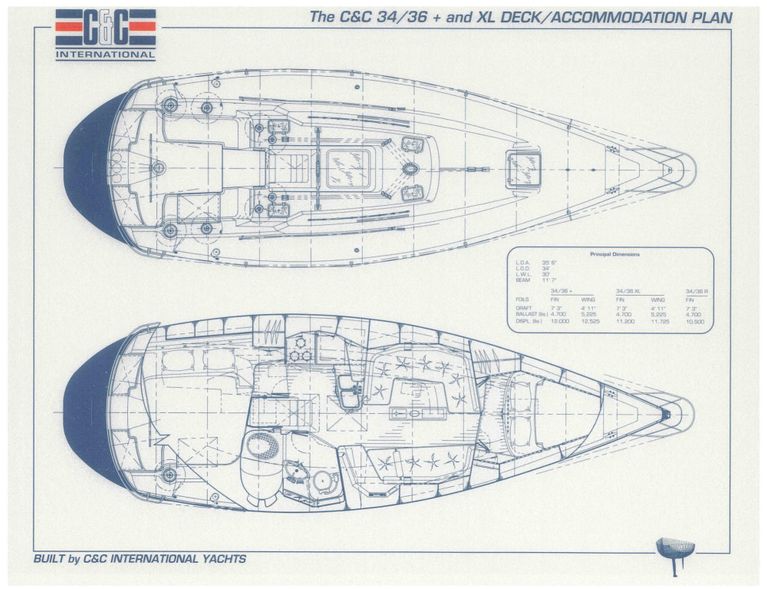
All the models have a forward and aft cabin. Additional berths are found toward the middle of the main cabin. The head with shower is located to starboard, just aft of the forward cabin. The galley features dual molded sinks, cupboard storage, icebox and a Force 10 propane stove. The boat was designed to carry 60 gallons of fresh water.
Some reviews noted the boat lacks adequate ventilation, particularly in the aft cabin. The adjacent galley can add to the heat, making the aft berth less comfortable. The main cabin has a large L-shaped settee to port and a centerline drop-leaf table. The settee has a removable backrest that extends aft to create a seat for the tiny chart table. The chart table has been criticized for its design and poor quality. A teak-and-holly sole, an oil-rubbed teak ceiling with wooden overhead handrails, and wood cabinets and bulkheads give the interior with a warm, traditional feel.
Engine
The C&C 34+ came with a 30-horsepower Yanmar 3GM30F diesel engine. The C&C 34R has a 30-horsepower Universal M-25 diesel. The boat carries 40 gallons of fuel. Owners report that the Yanmar engine moves the boat along steadily when needed, making it easy to maneuver in tight spaces. As one owner put it, “Engine access is adequate, though a little tight as you might expect, but everything is reachable.”
Underway
Scheaffer recalled sailing downwind when a squall hit with 30 knots-plus winds. His boat was under full sail, with the entire crew on the rail. The boat was surfing waves up the inlet to Atlantic City Marina. “I felt like I was driving a chariot with the bow waves emanating from just forward of the keel and shooting more than 20 feet out on either side,” he said. “It was great fun.” Wilson said the boat is powerful. “You do need to reef early as the boat is light. We sail a lot with one reef in the main. Mainly because we want to keep the boat flat so that we don’t spill anything. Plus it is just more comfortable and feels safer for the non-sailors on board,” he said. Wilson, who owns the wing-keel version that draws five feet, gave a thumbs up to the boat’s balanced helm. “Flat water or big waves, or big wind or light. It sails great in all conditions,” he said. “The huge rudder keeps the boat balanced. With the wing keel, we sail through some interesting shallow places.”
Conclusion
The C&C 34+ is a fast, capable offshore racer-cruiser with sleek lines and strong bones.
Principal dimensions:
LOA 35’6”;
LWL 30’10”;
Beam 11’6”;
Draft racing keel 7’5”, deep keel 7’3”, wing keel 5’;
Displ. 12,000 lb.;
Ballast 4,700 lb. ;
Sail area 669 sq. ft.
PRICE: The price for a C&C 34+ in 2021 ranged from a high of nearly $85,000 in Canada to a low of less than $40,000 in Florida.
DESIGN QUALITY: The C&C 34+ is a club racer-cruiser designed by Canadian naval architect Rob Ball and considered a classic among his lengthy list of boats created while serving as chief designer at C&C Yachts in Ontario from 1973 to 1990.
CONSTRUCTION QUALITY: Unlike the earlier version of the C&C 34 introduced in 1977, the C&C 34+ is made from stronger and lighter materials, primarily fiberglass and Kevlar. The hull and deck are balsa cored, which was innovative at the time.
USER-FRIENDLINESS: C&C 34+ owners tend to appreciate how their boats handle in a wide range of sea states. Traveler and winches can typically be controlled by the helmsman. The cockpit seats six and wide side decks and a clean layout promote easy crew movement.
SAFETY: The C&C 34+ is solidly built with a blend of fiberglass and kevlar. It has solid rod rigging, stainless deck hardware, lifelines, bow pulpit and abundant ballast in the keel to keep her upright in a blow. The deck is uncluttered by hardware.
TYPICAL CONDITION: First launched in 1989, some are 32 years old. Steve Wilson, who sails his 1990 C&C+ Last Call on Lake Huron isn’t concerned about the boat’s age. “Mine is in better shape compared to many newer boats I have seen, and that has to do with the C&C quality of construction,” he said.
REFITTING: The holding tank is somewhat small and may need enlargement. According to Wilson, the original two-blade propeller is on the small side and struggles to push the hull through large waves. He is upgrading to a three-blade Maxi prop.
SUPPORT: C&C Yachts is no longer in business. However, Rob Ball is still involved in the sailing industry and offers advice and opinions about the boats he designed. There are C&C owner groups with active online forums, including on Google and on Facebook at C&C Sailboat Owners Group and at C&C Sailors.
AVAILABILITY: At least five boats were for sale in the United States and southern Canada in the fall of 2021.
INVESTMENT AND RESALE: The boats are selling for $70,000 to $80,000 even though they were built more than three decades ago.
https://sailingmagazine.net/article-2478-cc-34%252B.html?current_page=2&218
C&C 34 + and 34R
I'm not sure why I chose that cold and wet Friday to go for a sail, but I did and in retrospect I had a nice sail. The afternoon was punctuated by a run-in with a boat that simply looked great from every angle. It was the new C&C 34R or plus under power and on its way back to the marina. Credit C&C's designer Rob Ball or having the confidence to give this boat strong and distinctive lines. As the boat slipped away and I admired it one last time from the quarter, all I could think of was I wish I hade designed it.
Let's dissect this design and see just what makes it so successful, I don't have any meaningful race results at this time, so I am not going to comment on the comparative speed of this boat. Initial indications are that the boat has plenty of speed, but keep in mind that it is in a very competitive size range and will go head to head against some of the newest and hottest IMS boats. Our discussion will focus on the design as seen on paper, being cognizant of the many variables, such as skipper, crew, sails, etc., that go into making a race winner.
Rob Ball has had but one job and that has been as a yacht designer for C&C. Rob started here in high school and has stayed with the company through various changes in management to the point where he has been chief designer for several years. So while the brochures give no individual credit for design, you can assume that you are looking at the work of Rob Ball when you see a new C&C. Of course Rob owes some of his skill to the very long list of talented designers that have also worked at C&C, not the least of which were the two Cs, George Cuthbertson and George Cassian. Ball has been well trained.
To begin with, the 34 is not 34 feet LOA. It is 35 feet 6 inches LOA. "Boy, this sure feels like a big 34-footer." It is. Second, this boat comes in an R version for racing and a plus version for cruising. Twenty-five have been built; 50 are on order.
In overall design, this new C&C follows the style set by the C&C 37R. The 37R was really a 39-footer and was quite successful on the race course. The 34 is relatively light for a C&C; in fact, it has the lowest D/L ratio of any C&C at 177. The new 34 also has the highest length-to-beam ratio of any previous C&C. The midsection shows a shape derived from IOR shapes but smoothed out and without any flat section at the centerline. The keel has a curved trailing edge to help reduce root chord then fills in this joint with a long fillet radius. The sweep angle of the leading edge is 25 degrees. Utilizing a bulb on the keel obviously dramatically lowers the VCG and allows the 34 to carry a very tall rig.
Just for fun I pulled out some old IOR certificates and began comparing righting moments at one degree with the 854 foot pounds of the new 34. This was one of those quick little looks that turned up some surprising data. Consider this: Ted Hood's 1972 One Tonner Robin had a righting moment of 1,003 foot pounds; a 34-foot Mull three-quarter-tonner had a RM of 607 foot pounds; Bruce King's Terrorist at 35 feet had a RM of 929 foot pounds; Peterson's Ganbare model had a RM of 780 foot pounds; and the venerable Pearson 36 had a RM of 894 foot pounds. Of course we are talking about a wide range of diverse boats.
While we are studying the hull, take the time to admire the sheerline of this design. There is nothing timid in this sheer. With the high bow the look is one of plenty of sheer spring, but in reality the sheerline itself is quite subtle. The transom features a splayed cutout that extends the cockpit and adds a very shapely look to the transom. Note the extreme aft location of the elliptical rudder.
The C&C tradition of excellence in deck design goes back a long way. A long way. Back to the days of the two Cs. C&C decks have always been the best. The result is a deck that enhances the lines of the hull and blends a high degree of art with a good dose of functionalism. The new 34 is indeed a handsome yacht.
One of the more interesting aspects of this deck design is the way the rudder post has been brought up through the cockpit sole with the steering quadrant mounted on top. A removable panel in the cockpit sole covers the quadrant until servicing is required. This feature provides excellent support for the rudder stock.
The rig of the new 34R gives the boat a strong power plant with a SA/D ratio of 22.9. Note the end boom sheeting on the main allowed by the long E. This puts the traveler right at the corner of the cockpit and frees up a lot of working area forward. The plus version has the traveler moved to the housetop and too far forward for my eye. The spar is a special section to accommodate triple spreaders. It is controlled with runners, checkstays and a babystay. The combination of large rig and large planform keel give the 34 quick acceleration out of the tack.
The accommodations of the two versions differ considerably. I know I could cruise very comfortably in either but it is clear that the cruising version was design oriented and not simply function oriented. This version has an amazing layout for a small yacht.
C&C has targeted two groups with the new 34. The R version is well refined for the owner who wants to race and the plus version certainly maximizes the cruising comfort. I think you could have a lot of fun in the C&C 34.
http://www.cncphotoalbum.com/reviews/perry/c&c34.htm
Web Link